AI Workflow for Consulting Scope Changes

A one-sentence client request can alter project margin, timing, and accountability. That is why consulting scope changes need a documented commercial decision, not a quick “yes” buried in email.
AI can organize source material, expose missing assumptions, and draft decision records. It cannot decide what the contract means, approve new work, or speak for the client.
A repeatable workflow keeps the engagement team responsive without giving away work by accident.
Establish the baseline before the request becomes work
No prompt can repair a weak baseline. The signed contract controls legal terms, while the statement of work turns those terms into work people can plan and approve. PMI describes the statement of work baseline as the reference point for changes to scope, cost, and schedule.
Collect the executed SOW, relevant exhibits, accepted assumptions, prior change orders, project plan, and written client decisions. Mark each document with its version and date. Drafts belong in the packet only when their status is clear.
Separate the four request types
Give each request an initial label before estimating it. The label can change after review, but it stops the team from treating every client message as billable extra work.
| Request type | What it means | Initial response |
|---|---|---|
| Clarification | The client asks how an included deliverable or acceptance criterion applies. | Confirm the shared interpretation in writing. |
| Correction | The team must fix work that missed an agreed requirement. | Resolve the defect under the existing agreement unless the contract says otherwise. |
| Internal delivery issue | The problem came from an estimate, staffing choice, or rework inside your team. | Address it internally. Do not present it as a client-funded change. |
| Legitimate scope change | The request changes deliverables, volume, assumptions, timeline, dependencies, or acceptance criteria. | Assess impact and obtain approval before starting the added work. |
Build a source packet with clear ownership
Create one controlled folder or workspace for the request. Include the original client wording, source documents, meeting notes, and the engagement owner’s name.
Record facts separately from interpretations. For example, “add regional segmentation to the analysis” is a request. “The client expects five new workshops” is an assumption until a source confirms it.
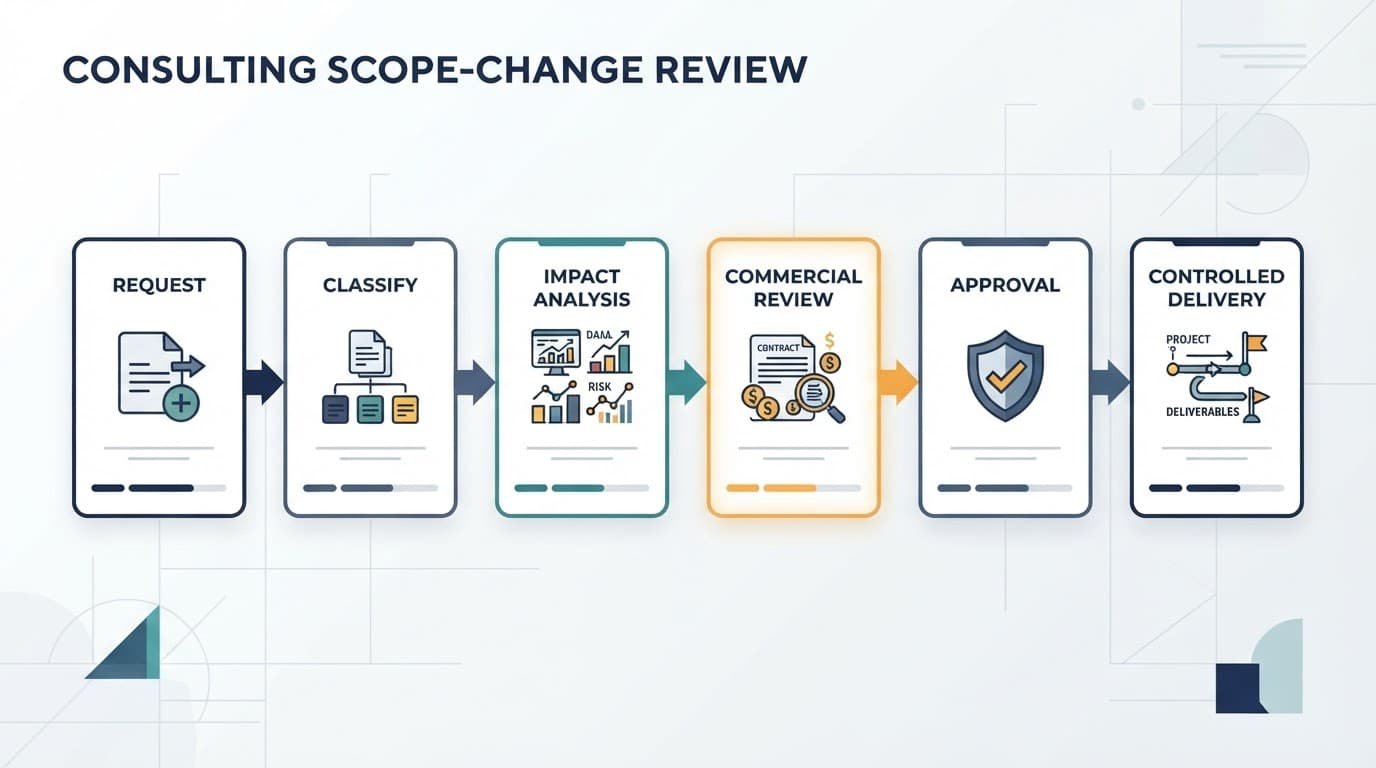
Stage 1 and 2: Capture and Classify Consulting Scope Changes
The first AI pass should create order from messy messages. It should not decide fees or make promises on behalf of the firm.
Capture the request without interpretation
Inputs include the client email, call notes, ticket, date received, requestor, and source packet. The output is a short request record with the requested outcome, affected deliverables, stated deadline, unknowns, and direct quotations.
Use a constrained prompt that tells the model where to stop:
“Use only the material below. Create a scope-change request record. Separate direct client requests from assumptions. Quote key wording, list affected deliverables, identify missing facts, and do not infer commitments or deadlines.”
The decision checkpoint is simple: confirm that the record preserves the client’s actual request. If the request is vague, ask the client a focused question before the team starts estimating.
Classify the request against the baseline
Give the AI the request record, signed SOW, change-order history, and acceptance criteria. Ask for a comparison that cites the relevant clause, section, or deliverable identifier.
“Compare the request record to the signed SOW and approved changes. Classify it as clarification, correction, internal delivery issue, legitimate scope change, or unresolved. Cite the supporting source for every conclusion. Flag conflicts and missing evidence.”
The output should be a classification memo, not a final ruling. The engagement manager checks every cited reference, then assigns an owner for the next action.
Stage 3 and 4: Assess Impact, Then Price the Work
A legitimate change has an operational effect before it has a price. Separate the new client ask from work already included in the delivery plan.
Assess the delivery impact with source citations
Inputs include the classified request, work plan, staffing assumptions, dependency map, delivery calendar, and available capacity. The output is an impact memo that shows what changes in effort, timing, client inputs, and risk.
“Based only on the approved baseline and request record, produce an impact memo. Identify added, removed, and modified work. List affected milestones, roles, estimated effort ranges, dependencies, client responsibilities, and open assumptions. Cite the source for each scope claim.”
Review the memo with the delivery lead. AI can group tasks, but it cannot know a consultant’s capacity, a specialist’s availability, or the effort hidden inside a client approval cycle.
Reject any statement that lacks a document citation or a named human estimate. A plausible paragraph is not evidence.
Produce commercial options from approved inputs
Give the model your approved rate card, pricing method, margin rules, approved estimate, and contract terms. Do not ask it to invent a fee or select an option without commercial review.
“Using the approved effort estimate and pricing rules below, draft two commercial options for the proposed change. State fee, timing, assumptions, exclusions, payment treatment, and the consequence of delayed client inputs. Show calculations and label every open item.”
The commercial owner verifies the arithmetic and decides whether a fixed fee, time-and-materials approach, or revised retainer fits the agreement. If added work only fixes an internal failure, keep it out of the client price discussion.
Stage 5 and 6: Secure Approval and Control Delivery
A well-written change record reduces misunderstandings. It also creates a clean handoff between sales, delivery, finance, and the client sponsor.

Draft an approval-ready change record
Inputs include the verified classification, impact memo, commercial option, contract template, and approval requirements. The output is a client-ready draft that states the proposed delta without hiding open items.
“Draft a proposed scope-change record using the approved template. Include the baseline reference, requested change, added and removed work, fees, timing, assumptions, exclusions, client responsibilities, and approval method. Mark unresolved facts as open items. Do not add legal terms or claim approval.”
A qualified commercial or legal reviewer must check the document against the contract. AI output is working material, not legal advice or an executed amendment.
The approval checkpoint is written client acceptance from the authorized person required by the agreement. A friendly reply from a project contact may not meet that standard.
Convert approval into delivery controls
Inputs include the approved change record, project plan, scope register, invoice schedule, and client communication plan. The output is an implementation checklist with owners and dates.
“Turn the approved change record into a delivery update. List plan changes, new milestones, staffing actions, invoice updates, client dependencies, acceptance criteria, and communication steps. Preserve the original baseline and identify every revised item.”
Update the project plan and commercial systems on the same day. If approval is still pending, continue only with original scope unless the agreement contains an emergency-work provision.
Protect Client Data and Preserve Evidence
Client context improves analysis, but it also raises confidentiality and privacy risks. Use only approved AI environments for client work, and minimize the data placed in each prompt.
Set a firm data boundary
Remove unnecessary personal information, credentials, pricing details, and proprietary files before analysis. When client data must remain intact, confirm that the provider arrangement includes suitable confidentiality and data-processing terms.
NIST’s Generative AI Risk Management Framework identifies privacy and confabulation as risks that need documented controls. The ISO/IEC 42001 standard also provides a management-system framework for governing AI use.
Do not place confidential material in public or unapproved tools. If a third-party processor will handle client information, check the SOW, privacy commitments, and client-consent requirements first.
Check facts and keep an audit trail
Ground every scope conclusion in the signed documents. Compare AI citations with the original SOW, prior approvals, and meeting records before the output reaches a client.
Keep a durable record of the request ID, source-document versions, prompt, model or system used, output, reviewer, final decision, approver, and timestamp. For accounting firms, the AICPA Confidential Client Information Rule may add professional obligations.
A defensible record shows which documents supported the decision, who reviewed the AI output, and what the client approved.
Run this concise scope-change checklist
Before work begins, confirm each point:
- The signed baseline and approved changes are in the source packet.
- The request has a clear classification and evidence for that classification.
- Delivery, timing, dependencies, and acceptance criteria have been reviewed.
- Pricing follows approved rates, estimates, and contract terms.
- Client data stayed within approved systems and access controls.
- The required client approver accepted the change in writing.
- The project plan, scope register, and invoice schedule match the approval.
Make AI a Disciplined Part of Change Control
Consulting scope changes become manageable when every request follows the same path: capture the facts, compare them to the baseline, assess impact, price with approved inputs, and secure written approval.
AI can reduce the time spent sorting documents and drafting records. Human judgment still protects the contract, the client relationship, and the economics of the engagement.