Build a Consulting Dependency Map Teams Can Maintain

A consulting dependency map shows what each workstream needs from others, who owns each handoff, and what happens if it arrives late. Teams can maintain it when every relationship has a clear meaning, an accountable owner, and an update trigger.
The useful artifact is a living delivery record, supported by a readable diagram. Start with the client outcome, then map only the dependencies that affect delivery or require deliberate coordination.
Key Takeaways
- A consulting dependency map is a living delivery record that connects handoffs to owners, acceptance evidence, and update triggers.
- Separate delivery blockers from informational relationships, and label scheduling links with accurate dependency types.
- Keep one authoritative register with acknowledged suppliers and recipients, clear completion conditions, and stable IDs.
- Review blocked dependencies and changed commitments weekly, and update records after project events that affect them.
Decide What Belongs on the Map
Separate delivery dependencies from technical relationships
A dependency is anything a product, component, project, user, partner, or staff member relies on. Identify dependencies before adding features, changing architecture, or updating environments, while teams can still change the plan.
For consulting engagements, distinguish three views. Project maps support project management by connecting activities, approvals, and their dependencies. Product maps connect capabilities and shared components. IT maps connect applications, services, infrastructure, and data.
Within IT maps, vertical dependencies connect different component types, such as an application and its supporting service. Horizontal dependencies connect similar components, such as two applications.
Start with consulting workflow handoffs if the delivery sequence itself is unclear.
Distinguish blockers from information
A critical dependency threatens an agreed milestone, acceptance condition, or material obligation if it fails. An informational relationship means another party needs visibility but doesn’t control whether work proceeds.
For example, client data access may block analysis. Sending the steering committee a progress update usually doesn’t.
Use solid lines for delivery dependencies and dotted lines for informational relationships. Document the convention so readers don’t interpret every connection as a scheduling constraint.
Build the First Consulting Dependency Map Together
Start with evidence, then challenge the handoffs
Begin with the signed statement of work, workplan, requirements, process maps, decision records, and acceptance criteria. Give each workstream lead three questions:
- What must another team provide before your work can proceed?
- What will you provide that another team needs?
- Which shared systems, people, or approvals could interrupt either handoff?
Salesforce’s exercise uses dependency mapping, as described in UserVoice’s dependency-mapping account. After its Release Kickoff meeting, each Scrum representative draws two whiteboard diagrams to build a dependency map: one shows what others must do for their team, and the other shows what their changes will affect elsewhere.
Michael Rutlege of Audible.com also recommends showing who depends on whom and whether work proceeds in parallel or sequentially.
Probe beyond the official architecture. Ask about staging servers used for unofficial reporting, spreadsheets that feed business processes, and specialists shared across workstreams.
Apply commitment rules before promising dates
Mike Cottmeyer of LeadingAgile recommends never committing to a feature that requires a component capability that doesn’t exist. Teams can sometimes commit against near-term roadmap capabilities, but should rarely commit against hard date-driven dependencies.
Translate those rules into engagement governance. Record whether an input exists, has an agreed delivery commitment, or remains an assumption. Track dependencies against those statuses.
Then connect each handoff to its approved requirement or client outcome. Backward tracing of dependencies exposes attractive extra work without an agreed purpose; forward tracing exposes requirements missing delivery or acceptance coverage.
Turn the Handoffs Into a Copyable Register
Keep one authoritative register for the dependency map. Generate diagrams from it where possible, rather than maintaining disconnected versions. Record delivery dependencies and informational dependencies for each handoff.
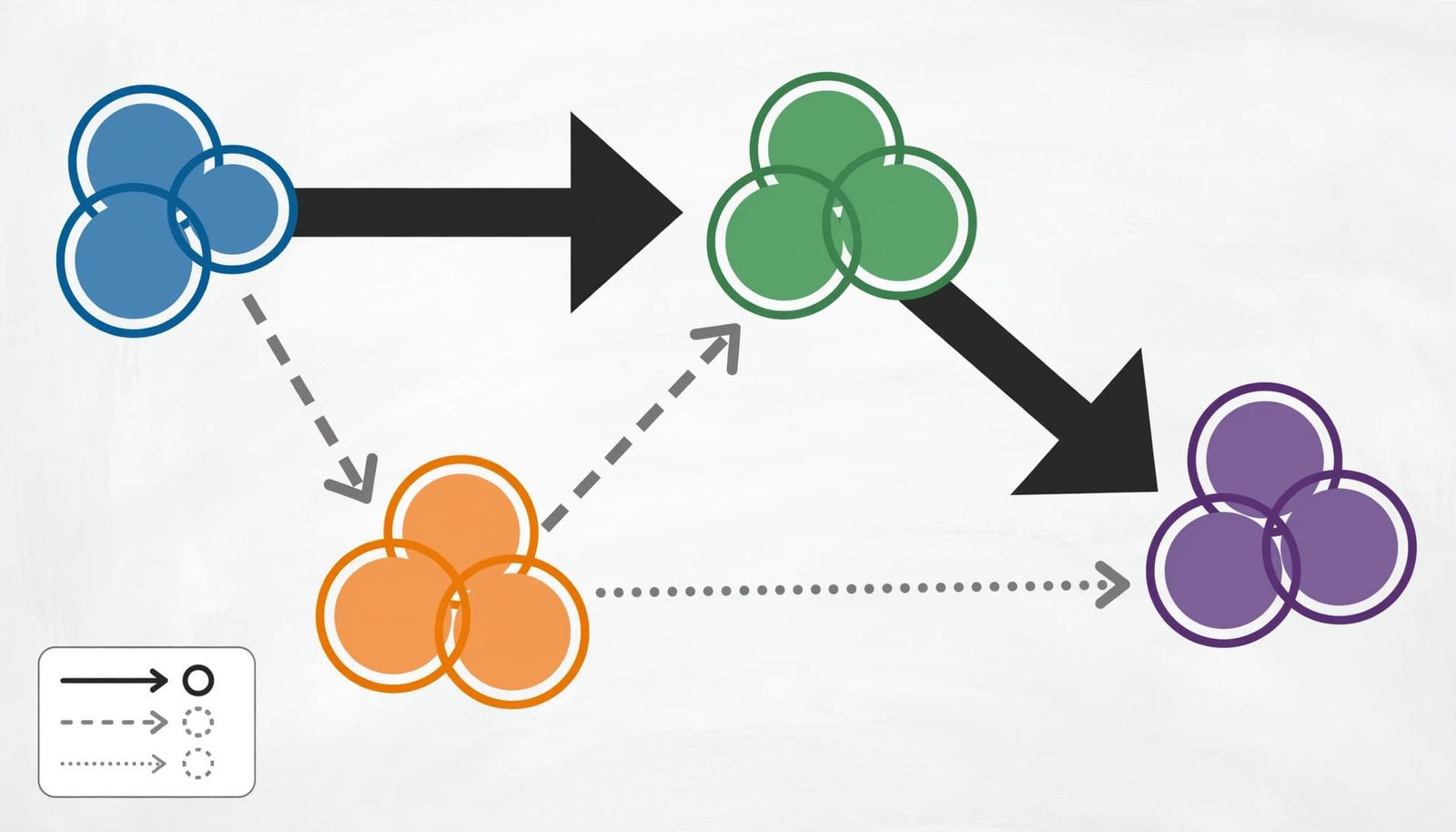
For monthly client reporting, the main chain is: client export, dataset validation, analysis, then client approval. Metric-definition work can proceed alongside report drafting.
This starter register separates delivery gates from visibility needs. Treat each dependency as either a delivery gate or an informational need.
| ID | Provider output and receiving work | Relationship | Accountable supplier | Acceptance evidence |
|---|---|---|---|---|
| D1 | Client export supports dataset validation | Finish-to-Start | Client data owner | Export and field definitions received |
| D2 | Validated dataset supports analysis | Finish-to-Start | Analytics lead | Data-quality checks passed |
| D3 | Approved metric definitions support report completion | Finish-to-Finish | Client reporting owner | Definitions approved |
| I1 | Draft findings inform the steering briefing | Informational | Engagement manager | Briefing shared; no delivery gate |
D1 and D2 can block analysis. I1 shouldn’t appear as a mandatory predecessor merely because the committee wants visibility.
Add required-by milestone, receiving owner, status, source reference, last-reviewed date, and next trigger to the working register. Keep stable IDs when descriptions or dates change.
Use precise acceptance evidence. “Data ready” leaves room for disagreement; “export received with agreed fields and reporting period” gives the recipient something assessable.
Before agreeing a row, have the supplier accept responsibility and the recipient accept the completion condition. An unacknowledged arrow is still a proposed relationship.
Describe Scheduling Relationships Accurately
The Project Management Institute’s scheduling guidance explains how project management teams classify dependencies and define each dependency’s timing. Classify each dependency using one of these four relationships:
- Finish-to-Start (FS): The successor cannot start until the predecessor finishes.
- Start-to-Start (SS): The successor cannot start until the predecessor starts.
- Finish-to-Finish (FF): The successor cannot finish until the predecessor finishes.
- Start-to-Finish (SF): The successor cannot finish until the predecessor starts.
SF is uncommon. A support transition can use it when outgoing coverage cannot end until incoming coverage begins.
Parallel work doesn’t mean independent work. Report drafting and metric review can overlap while still sharing a completion gate.
Also distinguish business-critical work from the schedule’s critical path. A critical path requires durations and scheduling logic; a red arrow alone doesn’t establish one.
Heathrow Terminal 5 used dependency mapping across more than 60,000 tasks to identify bottlenecks early. For smaller engagements, teams can use the same scheduling discipline to coordinate release schedules without reproducing that scale of detail.
Give Ownership and Updates a Routine
Assign one accountable owner per dependency
The supplier owns providing the input. The recipient owns assessing whether it meets the agreed condition. A named engagement manager maintains the overall map and resolves cross-workstream disagreements.
For external suppliers, name a client-side owner who can escalate commercially. A vendor’s help desk isn’t an accountable engagement owner.
Put unassigned relationships in an Ownership gaps view. Don’t hide missing accountability behind a department name.
People also need capacity evidence. Someone appearing on an organization chart doesn’t establish availability. Connect shared-specialist constraints to the consulting resource plan.
Review changes weekly and at delivery triggers

Make this weekly review part of project management, and focus on blocked dependencies, approaching gates, ownership gaps, and changed commitments. Review stable, satisfied dependencies only when something changes.
Update each dependency record immediately after scope approval, staffing changes, supplier slippage, architecture changes, or revised acceptance criteria.
Keep statuses simple: proposed, agreed, blocked, and satisfied. A supplier’s completion report doesn’t satisfy the record until the receiving owner accepts the evidence.
Store the register, decision history, and supporting documents in the agreed client workspace. Share filtered views with stakeholders rather than circulating competing master copies.
Track overdue gates, stale rows, and approval delays. These measures show whether maintenance is supporting delivery.
Choose Tools That Reduce Maintenance
Start with the client’s existing workspace
A spreadsheet or structured Notion table can hold the register. Miro or diagrams.net can provide the visual view. Jira, Asana, or Microsoft Project may suit teams already managing linked delivery work there.
Choose the system owners already update. Another standalone dashboard adds reconciliation work unless it replaces an existing record.
Automate technical discovery where it earns its cost
Application dependency mapping tools can uncover transitive dependencies, indirect links such as libraries required by a component’s direct connections. These tools often find links interviews miss. Include transitive dependencies when they affect ownership, risk, or delivery timing.
Device42’s discovery approach combines WMI, SSH, SNMP, and other methods. NetFlow data can reveal links involving machines it cannot access directly. Reconcile discovery results with the CMDB before updating the register.
Faddom’s agentless discovery approach advertises an initial map in about 60 minutes, with continuous updates and no agents or server credentials. Dynatrace emphasizes runtime observability, while ServiceNow ITOM connects discovery with service and CMDB records. Dynatrace’s observability data can help confirm whether suspected links appear in live traffic.
Keep technical constraints separate from general recommendations. G2 users have reported a 2TB system-disk ceiling for BMC Helix Discovery appliances.
AWS’s release notes say it closed Application Discovery Service to new customers on November 7, 2025, and directs newcomers to AWS Transform. Record any contractual 24-month post-transformation AWS usage commitment as a commercial dependency, rather than assuming it applies universally.
A CMDB can record system links, but discovery software won’t establish client approval authority or confirm a supplier’s contractual promise.
Prevent the Failures That Make Maps Unusable
Keep AI proposals separate from agreed commitments
ChatGPT or Claude can extract candidate relationships from approved notes and compare versions. Restrict processing to client-approved environments and retain source references.
Use a bounded prompt:
Using only these approved records, list proposed dependencies with supplier, recipient, required input, timing relationship, acceptance evidence, and source reference. Mark unsupported fields TBD. Separate informational relationships from blockers. Put missing owners under Ownership gaps. Do not invent dates or mark commitments agreed.
A named reviewer must check each proposed dependency against its source and confirm authority, capacity, and client acceptance. Treating a proposal as a commitment creates risk.
Retire obsolete links and preserve the handoff
Maps fail when teams capture every relationship, use vague arrows, or leave completed work active indefinitely. Filter by workstream and upcoming milestone; archive superseded links without deleting their decision history.
Treating a delayed dependency as approved scope expansion can create unplanned work and capacity conflicts. Route additional work through the agreed change-control process.
At handover, give the client a structured consulting handoff containing remaining dependencies, owners, source links, escalation contacts, and next review triggers.
Preserve that knowledge base for the next release. Ask each stakeholder what changed instead of rebuilding the map from memory.
Frequently Asked Questions
What should a consulting dependency map include?
It should show what each workstream needs, who supplies and receives each handoff, and what happens if an input is late. The register should also include acceptance evidence, status, source references, and review triggers.
How do delivery dependencies differ from informational relationships?
A delivery dependency can block a milestone, acceptance condition, or material obligation if it fails. An informational relationship gives another party visibility but doesn’t control whether work proceeds.
Who owns each dependency?
The supplier is accountable for providing the input, and the recipient is responsible for checking it against the agreed condition. A named engagement manager maintains the overall map and resolves cross-workstream disagreements.
How often should teams review the dependency map?
Teams should review it weekly, focusing on blocked dependencies, approaching gates, ownership gaps, and changed commitments. They should also update records after scope, staffing, supplier, architecture, or acceptance-criteria changes.
Can tools or AI maintain the dependency map automatically?
Discovery tools can uncover technical links, and AI can propose candidate relationships from approved records. A reviewer still needs to verify each proposed dependency, its source, authority, capacity, and client acceptance.
Keep the Map Useful After the Workshop
A maintainable consulting dependency map connects delivery decisions to agreed ownership and evidence. Its value comes from accepted handoffs, visible blockers, and updates tied to real project events.
Start with one milestone and its essential dependencies. Keep the register authoritative, distinguish information from constraints, and leave the client with a record they can operate without the consulting team.