Build a Verified 13-Week Cash Flow Forecast With AI

Build a 13-week cash flow forecast by starting with reconciled cash, scheduling expected receipts and payments, and refreshing the next 13 weeks every week. Use AI to organize records and flag exceptions, while finance owns the verified inputs, calculations, and approval.
A profitable business can still run short of cash when collections slip or payments cluster. Start with a spreadsheet that makes those timing differences visible.
Key Takeaways
- Forecast when money is expected to clear, rather than when revenue or expenses are recognized.
- Connect every material input to a dated source or an approved assumption.
- Let AI organize data and identify exceptions, but keep calculations inspectable and approval with finance.
- Replace completed weeks with actuals, explain differences, and add another week to maintain the horizon.
Set Up the 13-Week Cash Flow Forecast
A rolling forecast covers 13 weekly periods. After one week closes, another enters the horizon. Ripple Treasury’s forecasting explanation describes this weekly, rolling structure.
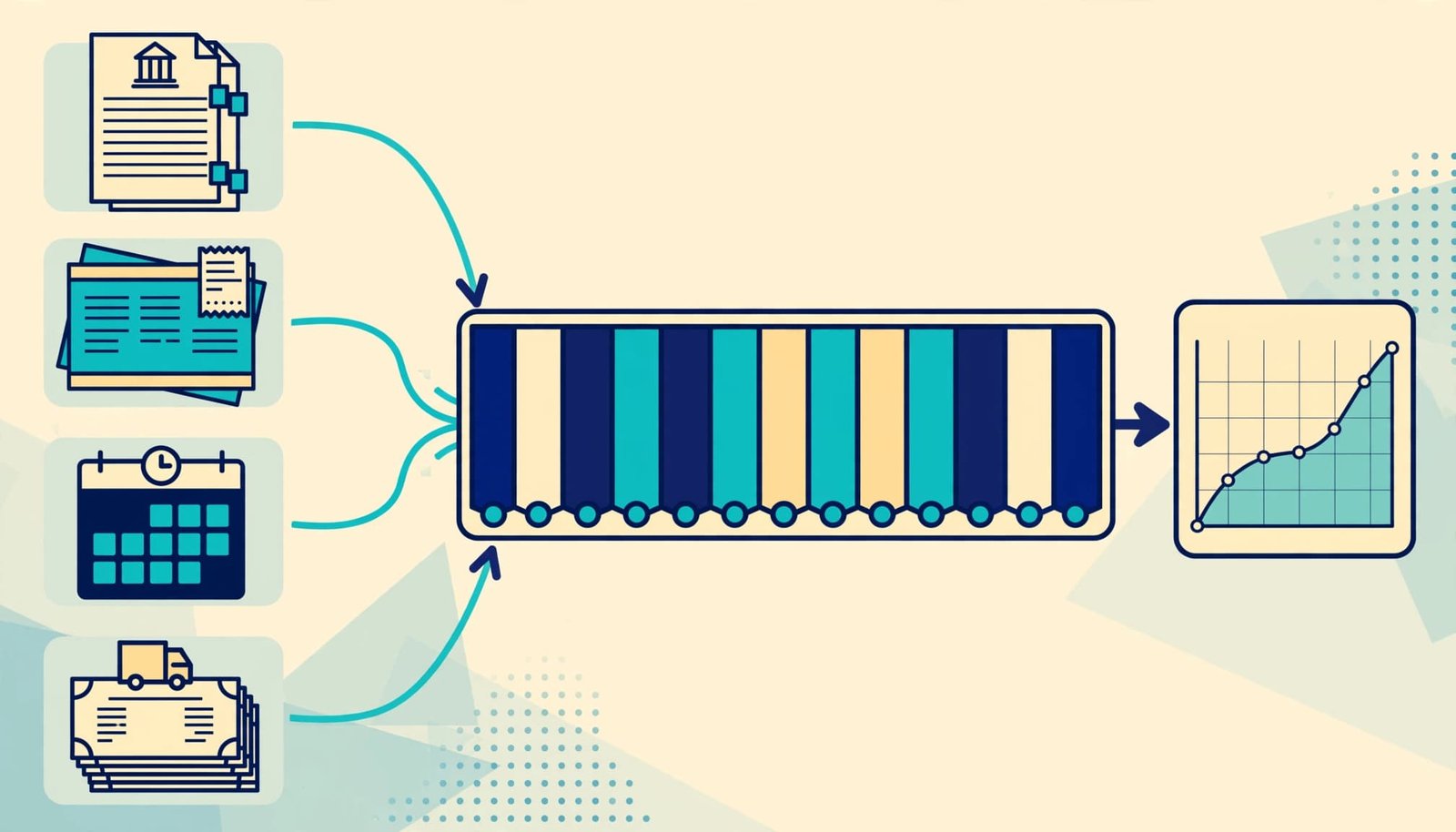
Define the boundaries first
Choose consistent week-ending dates, a bank cutoff, reporting currency, and entity scope. Keep restricted cash separate from money available for operations.
Use separate workbook tabs for source extracts, assumptions, the forecast, and actual-versus-forecast results. Give each source a report date and version. Otherwise, an updated invoice file can silently change the evidence behind an approved forecast.
Build the weekly calculation
The Wall Street Prep cash flow model uses direct cash receipts and disbursements.
The calculation is straightforward:
Closing cash = opening cash + receipts – payments
Each week’s closing cash becomes the following week’s opening cash. In Excel, if B2 contains opening cash, B3 receipts, and B4 payments, enter =B2+B3-B4 in B5. Then link C2 to B5 with =B5.
Keep operating receipts, operating payments, and financing movements on separate rows. Borrowing should never disappear inside customer collections.
Assemble a Controlled Input Package
An accounting export becomes a forecast input only after its scope, totals, dates, and meaning are understood. Keep an untouched copy of every source extract.
Reconcile opening cash
Document how bank balances reconcile to the ledger at the chosen cutoff. Record outstanding checks, deposits in transit, and other reconciling items under a consistent treatment.
Count each pending movement once. For example, a payment already reflected in the starting available balance must not reduce forecast cash again.
Exclude unavailable balances from operating liquidity. Also eliminate transfers between included bank accounts, because those transfers don’t change consolidated cash.
Gather the payment evidence
Use a source register to connect each forecast category to its supporting records.
| Input | Supporting evidence | Timing basis |
|---|---|---|
| Customer receipts | Receivables aging, collection notes | Expected collection date |
| Supplier payments | Payables aging, payment-run schedule | Expected bank-clearing date |
| Payroll and benefits | Approved payroll calendar, funding notices | Funding date |
| Debt service | Loan schedules, lender notices | Principal and interest dates |
| Committed spending | Contracts, purchase orders, tax schedules | Contractual payment dates |
Include rent, insurance, subscriptions, taxes, and committed capital expenditure even when no invoice has arrived.
Record currency, units, entity, extraction date, and responsible owner. My Excel analysis prompts help organize duplicate, missing-field, and inconsistent-date checks before records enter the model.
Translate Records Into Expected Cash Weeks
Due dates provide a starting point, but they don’t always predict settlement. Forecast the expected cash movement using documented evidence.
Schedule collections using payment evidence
Start with open receivables, then adjust expected collection dates using customer commitments, dispute status, and observed payment patterns. Preserve the invoice identifier so finance can trace each scheduled receipt.
Keep existing receivables separate from collections on future sales. Otherwise, the same sale can appear in both the aging schedule and a revenue-based receipt estimate.
An unpaid invoice shouldn’t remain in a completed week. Move its expected receipt date using current collection evidence, and retain the original forecast for variance analysis.
Schedule disbursements using commitments
Map supplier bills to payment runs and expected clearing dates. Schedule payroll funding, benefits, payroll taxes, debt principal, and interest separately.
Forecast credit-card settlements without also counting the underlying card purchases as bank payments. Similarly, exclude depreciation because it doesn’t create a payment.
For inventory-heavy businesses, purchasing commitments can create pressure before inventory reaches cost of goods sold. CLA’s manufacturing cash flow guidance connects rolling forecasts with earlier visibility into timing problems. Use supplier schedules and purchase commitments rather than spreading accounting expenses evenly across weeks.
Give AI Narrow, Reviewable Tasks
ChatGPT and Claude can help normalize descriptions, propose categories, compare versions, and draft exception logs. They can’t authenticate a bank export or approve a collection assumption.

Organize records without changing evidence
Use only an approved AI environment. Remove unnecessary customer identities, bank details, employee information, and confidential contract terms.
Give the assistant a copy of the controlled inputs, field definitions, and approved mapping rules. Ask it to flag possible duplicates, missing dates, inconsistent units, and unmatched source identifiers.
Require a proposed-change table rather than allowing silent edits. Missing amounts should remain visibly unresolved, not become plausible estimates.
Use a bounded forecast prompt
A focused instruction keeps the task inspectable:
“Using only the supplied records and approved timing rules, propose weekly cash categories and settlement weeks. Preserve source IDs, currency, amounts, and original dates. Flag duplicates, missing inputs, and conflicting dates. Separate documented commitments from assumptions. Don’t invent amounts, probabilities, or explanations. Return proposed mappings and an exception log for finance review.”
Keep approved timing judgments in an assumption register. My assumption register prompts help capture the evidence, owner, approval status, and next review date.
Test the Workbook Before Approving It
A correct-looking cash total doesn’t prove that the workbook responds correctly. Finance should review both source coverage and spreadsheet behavior.
Reconcile totals and test formulas
Reconcile imported totals to source reports before reviewing forecast outputs. Investigate omitted records, duplicated payments, and sign reversals.
Then change one input and trace its effect across all remaining weeks. Moving a receipt one week later should reduce the earlier week’s cash and restore it when collected.
Inspect calculation cells for hardcoded results. My AI financial model review guide covers formula integrity and assumption testing.
Assign approval responsibilities
The preparer resolves data exceptions. Receivables and payables owners support settlement assumptions. The controller or finance lead approves the forecast and material changes.
Keep confirmed formula errors separate from questions awaiting operational evidence. A second AI response isn’t independent validation.
Retain the source version, prompt, AI output, reviewer changes, and approval record. That trail explains why the published forecast differs from the assistant’s draft.
Run a Consistent Weekly Refresh
A forecast becomes useful through recurring maintenance. Choose one owner and a publication deadline so teams know which version supports decisions.
Reconcile and roll forward every Monday
A practical cadence starts Monday morning with the previous week’s cleared bank transactions and refreshed receivables and payables reports.
Replace the completed week’s projection with actual receipts and payments. Reconcile actual closing cash, archive the prior forecast, and compare its predictions with the cleared transactions.
Next, remove the completed week from the forward view and add a new thirteenth week. Refresh collections, payment runs, payroll, debt schedules, and commitments across the entire horizon.
Review exceptions and publish on Tuesday
On Monday afternoon, category owners explain material differences. Separate timing changes from amount changes, classification errors, and missing transactions.
A delayed receipt usually shifts cash between weeks. A cancelled receipt reduces expected cash overall. Those differences need different responses.
On Tuesday, the finance lead approves the updated forecast and records actions, owners, and decision dates. During the week, refresh material changes immediately rather than waiting for Monday.
AI can draft the variance narrative, but explanations need evidence. An unexpected supplier payment alone doesn’t prove overspending.
Turn Forecast Results Into Cash Decisions
Set a management-approved minimum cash balance. Display weekly headroom above that floor alongside closing cash, then highlight the lowest projected balance and its week.
Keep available borrowing capacity separate from bank cash. Show approved draws as financing receipts, with interest and repayment consequences included.
Run downside cases using approved assumptions, such as delayed collections or accelerated supplier payments. Keep the base case intact so leadership can compare outcomes.
Actions should match the cause. Collection delays call for customer follow-up or dispute resolution. Committed spending may require rescheduling within agreed terms. A financing gap needs an explicit funding decision.
Record the cash effect, implementation date, owner, and approval for each action. Proposed savings or borrowing don’t enter the base case until their assumptions receive approval.
Frequently Asked Questions
Does a cash forecast replace the budget?
A budget measures planned revenue and expenses over its reporting periods. A short-term cash forecast focuses on settlement timing and liquidity. Use both, because recognized profit doesn’t show whether cash will cover next week’s obligations.
Can AI maintain the forecast automatically?
AI can assist with recurring imports, mappings, comparisons, and commentary. Finance still needs to reconcile sources, approve assumptions, test formulas, and authorize publication. Keep any automated changes reviewable, with an exception queue and retained versions.
Keep Every Cash Decision Traceable
A reliable forecast connects available cash, expected settlement dates, and visible calculations. AI reduces repetitive organization and review work, while finance retains approval responsibility.
Build the source register and weekly calendar first. Then maintain the rolling horizon through reconciled actuals, documented assumptions, and decisions tied to the weeks when cash moves.