Ansoff Matrix: A Practical Guide for Consultants

The Ansoff matrix helps companies compare four growth strategies based on whether their products and markets are existing or new.
Its strength is making strategic choices explicit. However, a completed grid doesn’t tell your client which opportunity deserves investment.
Start by defining the business boundary, then connect each option to evidence and a decision. As a growth strategy framework, the matrix helps consultants organize options before assessing their economics, risks, and delivery requirements.
Key Takeaways
- The four strategies are market penetration, product development, market development, and diversification.
- Market penetration usually carries the lowest uncertainty; diversification carries the highest.
- Define “new” relative to the client’s current offering and customers.
- Support recommendations with evidence, accountable owners, performance measures, and review points.
What the Ansoff Matrix Shows
The product market matrix, also called the Ansoff growth matrix, maps growth using familiar or unfamiliar products and markets.
These two dimensions produce four options.
| Product offering | Existing market | New market |
|---|---|---|
| Existing product | Market penetration | Market development |
| New product | Product development | Diversification |
The grid classifies a growth move. It doesn’t establish demand, profitability, or the client’s ability to execute.
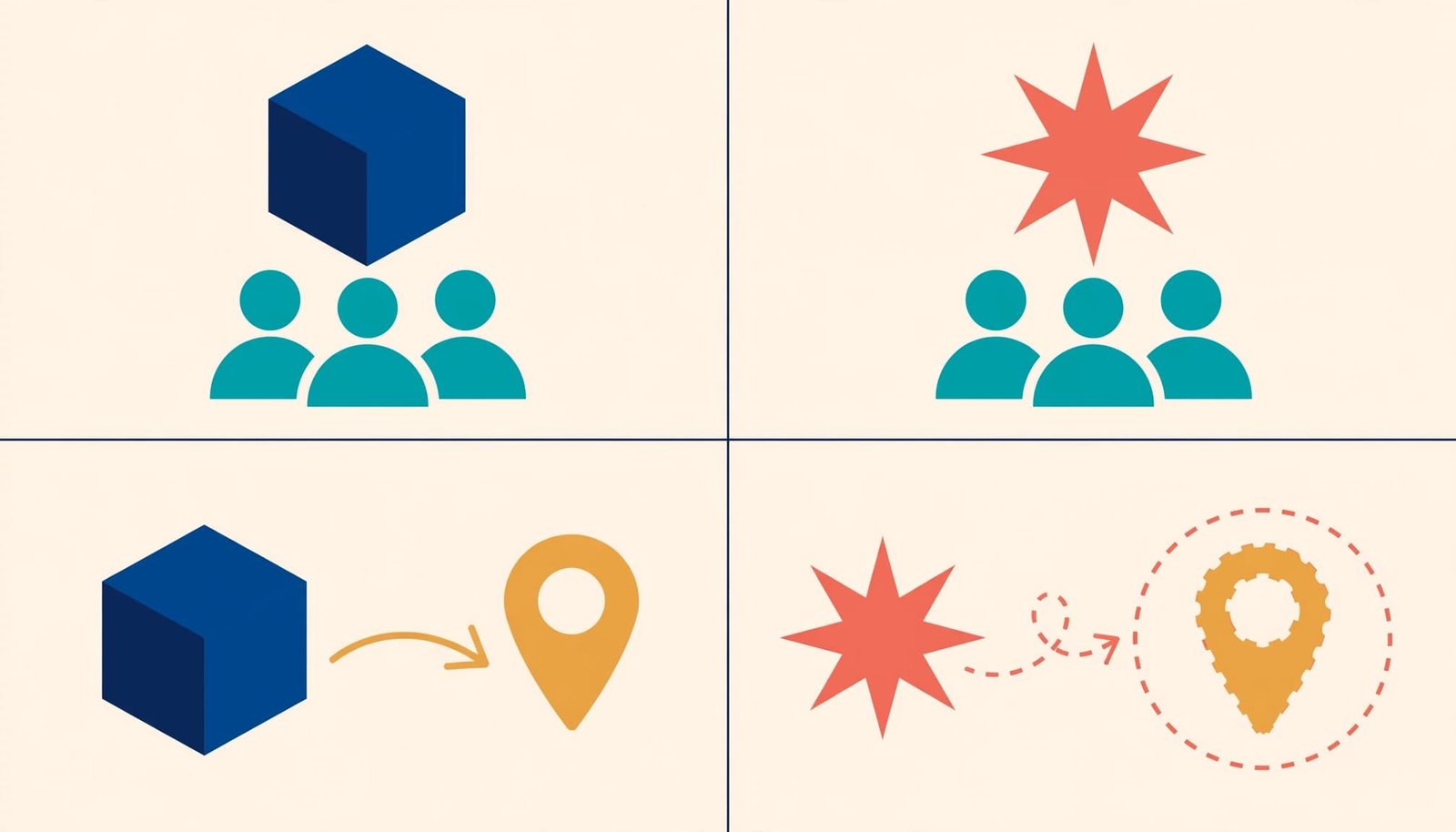
Where the framework came from
Igor Ansoff developed the model. Lucid dates it to 1957 and his Harvard Business Review article, Strategies for Diversification. Toolshero places its development in the 1960s, referencing his 1965 book, Corporate Strategy.
These accounts emphasize different publications. In client work, the useful distinction is between familiarity with the offering and familiarity with the market.
Define what counts as new
Agree on the product and market boundaries before placing initiatives, since novelty depends on both.
A market might mean a geography, customer segment, or use case.
Similarly, a new package doesn’t necessarily create a new product. An online channel can support penetration if it reaches existing customers, or market development if it reaches a different segment. Record that reasoning beside the initiative.
Market Penetration: Sell More in Existing Markets
A market penetration strategy increases sales of existing products to existing markets through greater purchase frequency, retention, or market share.
Typical tactics include lower prices, stronger promotion, wider distribution, and acquiring a competitor operating in the same market.
Nike illustrates the logic when it promotes established footwear to customer segments it already serves. The product and target market remain familiar, while commercial execution changes.
The benefit is access to existing customer knowledge and operating capabilities. However, discounting can increase volume while reducing contribution margin. Competitors may also match promotions.
For a client engagement, separate incremental sales from purchases pulled forward or shifted between channels. Track contribution margin alongside retention, purchase frequency, and market share where reliable data exists.
Product Development: Add Offerings for Existing Customers
Product development introduces a new offering to a market the company already serves.
Apple’s introduction of Apple Watch to its existing customer base illustrates this strategy. The company could draw on established customer relationships, although the offering required different product capabilities.
Execution can involve new product development through R&D, acquiring a competitor’s product or technology and developing it further, or forming partnerships for capabilities and distribution access.
Established customer relationships can support an innovation, but they don’t prove demand for a different product.
Consultants should test willingness to pay, development cost, adoption, and cannibalization. Measure incremental contribution after accounting for sales displaced from existing offerings. For services businesses, the same logic applies to a new advisory service sold to established clients.
Market Development: Reach New Customers
Market development takes an existing product into a new geography, customer segment, or use case.
IKEA’s expansion into China and the Middle East illustrates this route. Its underlying furniture proposition entered markets with different customer expectations and operating conditions.
Online selling and franchising can also help reach those new customers, as long as they target genuinely new audiences.
Toolshero identifies favorable conditions: transferable technology, profitable customers in the target market, and similar consumer behavior. These reduce the amount the business must relearn.
The benefit is growth without developing an entirely new offering. However, localization, regulation, logistics, and acquisition costs can weaken the economics.
Assess segment-level demand and contribution after local operating costs. Then compare customer acquisition cost, retention, and payback across markets rather than assuming the home-market model transfers unchanged.
Diversification: Enter a New Product and Market
A diversification strategy combines a new offering with a new market. Because both sides are unfamiliar, it generally carries the greatest uncertainty.
Amazon’s move into cloud infrastructure through Amazon Web Services illustrates diversification relative to its online retail business. It also demonstrates relatedness through shared technical capabilities.
Related diversification uses capabilities or assets that transfer between activities. Unrelated diversification offers little such overlap.
Toolshero’s diversification explanation contrasts a leather shoe maker entering wallets with one entering phones. Wallets share material and production knowledge; phones offer far less operational overlap.
However, the quadrant still depends on market scope. Wallets sold to existing shoe customers could count as product development.
Toolshero also describes Ansoff’s view that growth proceeds in stages, placing diversification after the other three strategies. Treat this as a sequencing principle rather than an automatic approval rule. Demonstrate which capabilities transfer and budget for those that don’t.
How to Use the Matrix in a Client Engagement
Run the matrix around a specific decision, with the sponsor, finance, commercial, and delivery teams involved. High Alpha recommends beginning with SWOT; our SWOT analysis guide connects that diagnosis to a defined business choice.

Lucid’s five-stage process provides a practical sequence:
- Outline the matrix. Define the business unit, current products, markets, objective, and planning horizon. Agree on what makes a product or market new.
- Analyze options. Describe each initiative as a specific offer for a specific customer group. Capture demand evidence, capability requirements, investment, and dependencies.
- Assess risk. Compare demand uncertainty, capability gaps, financial exposure, and reversibility. Eliminate options that fail mandatory constraints before scoring attractive features.
- Outline contingencies. Identify assumptions that could break the case. Assign warning indicators, response owners, and conditions for pausing or stopping investment.
- Choose the approach. Recommend a preferred option, explain the trade-off, and distinguish funding a pilot from approving a full rollout.
Keep the executive matrix short. Store interview findings, calculations, assumptions, and disagreements in a supporting record.
The deliverable should explain why the recommendation wins, which evidence supports it, and what would change the decision. An attractive quadrant label can’t substitute for that reasoning.
Compare Strategic Risk Without False Precision
Lucid and Toolshero place penetration at the low-risk end and diversification at the high-risk end. The Corporate Finance Institute’s framework explanation also organizes the four strategies around increasing product and market unfamiliarity.
However, quadrant position is only an initial risk assessment.
Assess exposure and evidence separately
The two intermediate quadrants don’t have a universal risk order. An adjacent customer segment may require fewer changes than a technically demanding new product.
Compare options against client-approved criteria: economics, strategic fit, capability requirements, time to value, and downside exposure. Our consulting recommendation matrix provides a structure for that comparison.
Attach a source, calculation, interview finding, or explicit assumption to every material score. Keep evidence confidence separate from expected impact. A large opportunity supported by weak evidence needs investigation before commitment.
Test whether the recommendation holds
Change uncertain assumptions and agreed criterion weights to see whether the preferred option changes. If small adjustments reverse the ranking, present a conditional recommendation.
Also examine shared capacity. Several attractive initiatives may depend on the same product team or specialist.
Finish the risk comparison in this order: penetration usually has the lowest uncertainty; product and market development each add unfamiliarity; diversification adds both. Then explain any client-specific exception.
Where the Matrix Needs Other Analysis
The Ansoff matrix simplifies growth choices, but its two dimensions leave important questions unanswered.
Competitors and external conditions remain outside it
The grid doesn’t model competitor retaliation. A rival can match prices, strengthen distribution, or make market entry less attractive.
Lucid recommends PEST analysis, covering political, economic, social, and technological factors, alongside Porter’s Five Forces for new-market assessment. Our PESTLE analysis guide adds legal and environmental factors.
Use these tools to test conditions that could change the recommendation. Avoid adding frameworks that produce more slides without resolving a decision.
Product and market boundaries can overlap
Critics question the model’s logical consistency because a genuinely new product may create a new market. That makes the distinction between product development and diversification debatable.
Resolve borderline cases through explicit definitions, then focus on the actual capability gaps and economics.
For deeper portfolio decisions, Toolshero suggests the BCG Growth-Share matrix and GE matrix. BCG examines relative market share and market growth. Those axes answer a different question from which product-market direction to pursue.
Frequently Asked Questions
Can consultants use the matrix for services or nonprofits?
Yes. Treat the service or program as the offering and define the relevant client or beneficiary group. A new service for existing clients is product development. An existing program introduced to a new beneficiary group is market development. Measure outcomes appropriate to the organization.
Can AI help build an Ansoff matrix?
AI can organize approved notes, suggest classifications, and flag missing evidence. Give it the market definition, options, constraints, and source references.
Require it to separate facts, interpretations, and unknowns. Unsupported output remains a research question, not a client finding. Keep confidential material within approved data controls.
Turn the Matrix Into a Defensible Recommendation
The Ansoff matrix makes growth choices easier to discuss by separating product and market unfamiliarity. Its value depends on the evidence behind each option, not the neatness of the grid.
End the engagement with a preferred move, an accountable owner, a performance measure, and a review point. State the conditions that would change the recommendation so the client can respond when the evidence changes.