AI Stakeholder Mapping for Consulting Projects

Most consulting projects don’t stall because the workplan is weak. They stall because someone with authority, trust, or a quiet veto wasn’t understood until a decision was already in motion.
AI stakeholder mapping helps teams examine more evidence than a spreadsheet review can handle. Yet software can’t tell you why a sponsor, union representative, regulator, or operating leader will act a certain way. That calls for interviews, context, and client validation.
Used with discipline, this workflow can turn scattered notes and communications into an evidence-backed map. It can also support better decision-making processes that project teams can explain and own.
Key Takeaways
- AI stakeholder mapping helps consulting teams extract, compare, and organize evidence from interviews, workshops, surveys, communications, and project documents.
- AI can identify entities, concerns, relationships, and changing themes, but consultants and clients must validate meaning, influence, intent, and missing stakeholders.
- A defensible stakeholder map records roles, influence, interest, stance, confidence, evidence sources, relationship types, and clear engagement actions.
- Effective workflows define the decision, stakeholder boundary, approved data sources, governance controls, review steps, and accountable owners before analysis begins.
- Confidentiality, consent, bias checks, version history, and audit trails are essential when stakeholder analysis involves sensitive personal, employee, commercial, or community information.
What AI stakeholder mapping adds to consulting work
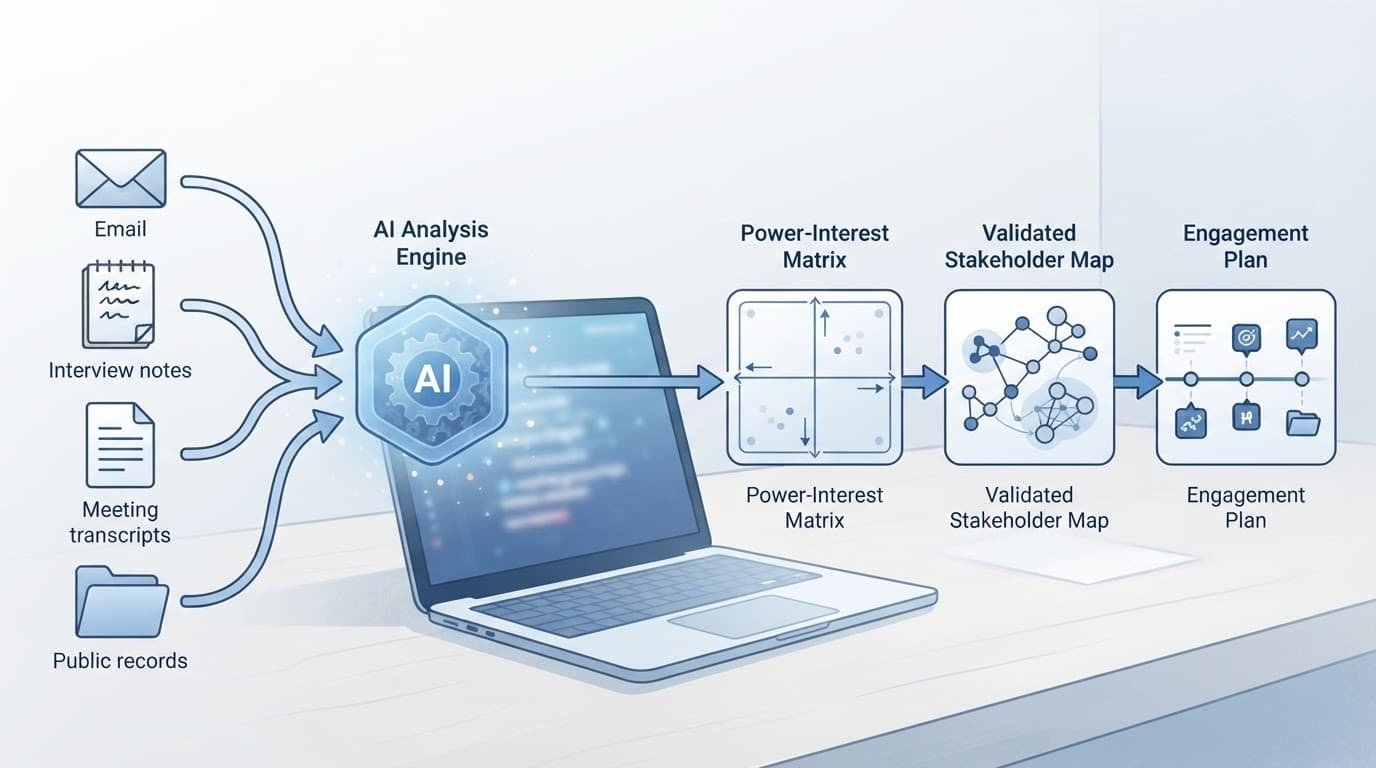
In project management, stakeholder analysis identifies people and groups that can affect a project or feel its effects. PMI’s stakeholder analysis guidance treats identification and requirements analysis as central project practices. AI adds speed when evidence sits across interview notes, workshop transcripts, surveys, email summaries, and project documents.
AI handles volume, consultants supply meaning
With approved data, natural language processing and machine learning algorithms can extract names, organizations, stated concerns, recurring issues, and references between people. They can group comments about the same topic, even when teams use different language.
That work saves time, especially during discovery. However, an AI model can’t reliably distinguish a passing complaint from a political signal. It also can’t know that a low-profile executive has the final word unless the client confirms it.
AI should augment consultant judgment, not replace relationship knowledge, interviews, and client validation.
A map should drive decisions, not become a directory
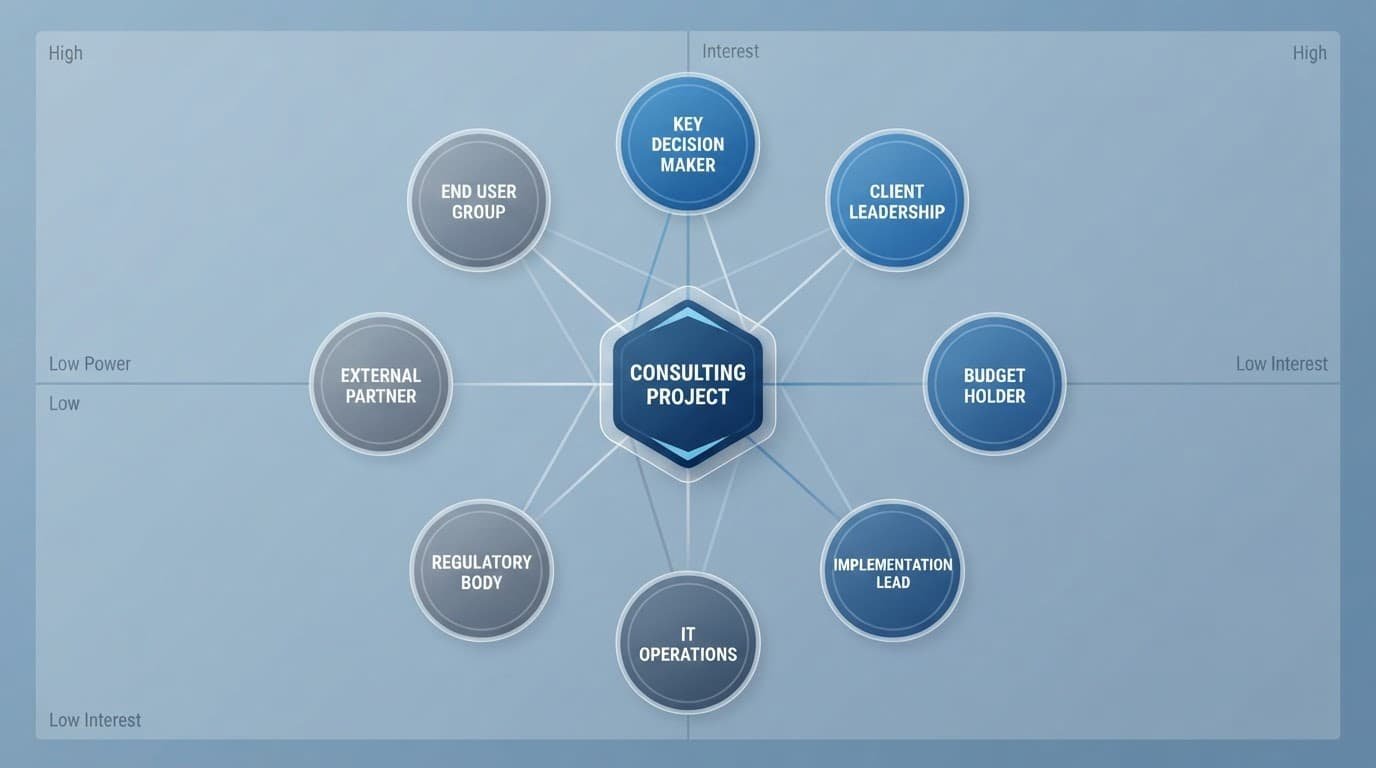
A useful map goes beyond names and job titles. For each stakeholder, record their role, level of influence, interest in the outcome, current stance, key concerns, relationship links, confidence level, and next engagement action.
A stakeholder matrix gives the team a shared view of those factors. Yet the strongest maps also state what evidence supports each classification. That discipline keeps assumptions from becoming facts in the final steering-committee deck.
Define the stakeholder boundary before collecting data
Before any client material reaches an AI system, agree on the decision the stakeholder analysis will support. A transformation program may need several maps, because one may support strategic planning while another supports investment approval or local adoption.
Set scope around a decision and time horizon
Start with a decision, a milestone, and a stakeholder boundary. Then ask:
- Who can approve, delay, fund, block, or redirect this decision?
- Who will absorb material operational, financial, regulatory, or reputational effects?
- Who has informal influence over people in either group?
A six-week diagnostic needs a tighter scope than a multi-year infrastructure program. A product development program should include target users alongside sponsors, delivery owners, and affected operational groups. A multi-year infrastructure program may also require regulators, community groups, suppliers, future operating teams, and groups affected by policy or location choices.
Establish data limits with the client
Next, write down which sources are permitted during approved data collection. Interview notes and approved workshop outputs may be in scope. Personal messages, HR files, legal advice, health information, and unofficial recordings may be out of scope.
Public availability does not grant permission to analyze information for every consulting purpose.
Confirm whether the client permits transcripts, survey comments, CRM records, or communication metadata to enter the workflow. Also confirm the client’s data privacy limits and establish governance controls for retention periods, access roles, approved platforms, and deletion procedures before the team starts collecting evidence.
Build an evidence-backed stakeholder inventory
The inventory is the evidence base beneath the presentation map and the working record for stakeholder analysis. It should be detailed enough for analysis but controlled enough to protect sensitive information.
Collect sources by reliability, not convenience
Build a source register that records the document, owner, date, sensitivity level, and permitted use. Begin with formal governance documents, organization charts, approved interview notes, survey results, meeting decisions, and client-provided contact lists.
Then compare the evidence. A stakeholder named in a project charter may hold formal accountability, while interview comments may reveal operational dependence or unresolved concerns. Machine learning algorithms can suggest recurring entities or overlapping evidence across those sources, but consultants should review duplicate names and possible false matches.
When teams analyze public records or public social posts, test relevance and consent first. Public content can be outdated, incomplete, or unrelated to the decision at hand.
Make every inference traceable
Use three labels in the inventory: known, inferred, and unknown. A direct quote from an interview is known evidence. A likely relationship based on repeated mentions is an inference. A missing view from a key group is unknown.
Useful stakeholder matrix examples show how structured fields improve review. Add two more fields that AI outputs often lack: source reference and confidence rating.
If the model suggests that two leaders are aligned, require it to show the relevant source excerpts. If evidence is absent, log a validation question instead of accepting a polished guess.
Use AI to improve power-interest grids
As part of stakeholder analysis, the power-interest matrix remains useful because it forces a practical question: where should the team spend scarce attention? A grid alone can become static, especially when a program changes direction or public pressure rises.
Score observable signals, not personalities
Use clear scoring criteria before asking AI to organize evidence. For power, consider formal authority, control of funding, technical veto rights, ability to mobilize others, and regulatory authority. For interest, consider direct impact, stated attention, resource commitment, and exposure to project risk.
Score each factor on a defined scale, such as one to five. Then document the rationale in plain language. A power-interest grid is more defensible when a reader can see why someone sits in a quadrant. Use those positions to shape engagement strategies, including communication frequency and decision-making involvement.
Avoid labels such as “difficult” or “supportive” without evidence. They invite bias and don’t tell the team what to do next.
Track stance, change, and confidence
Add three fields beside the usual grid: current stance, change since the last review, and confidence in the assessment. Someone with moderate power but rapidly declining support may need more attention than a stable high-power sponsor.
AI can compare themes across dated notes and flag changes in language. Still, it may confuse frustration with opposition, or enthusiasm with commitment. A consultant should review source material before assigning a stance label.
Refresh the grid after major decisions, missed milestones, leadership changes, public announcements, or new risk findings. A quarterly update may be too slow during a sensitive change program.
Find informal influence without treating inference as fact
Formal organization charts rarely show who people seek out before making decisions. Relationship intelligence can expose patterns, but it needs strict definitions and careful review.
Define every tie before drawing a network
A network map should explain what each line means. It may indicate a reporting relationship, a decision dependency, a repeated co-mention, a trusted adviser relationship, or a shared issue. Never use one vague “influence” line for all of them.
Relationship intelligence is meaningful only when each relationship type is defined and supported by evidence.
A 3-D network map can help when geographic location, time, or project phase adds a meaningful third layer. Yet it can obscure dense relationships and make visual representations difficult to read. Start with a readable two-dimensional view, use filters, and simplify the 3-D network map before client presentation. Retain a clear export for client review.
A basic stakeholder analysis method remains a sound foundation. Network analysis should add evidence to that foundation, not distract from it.
Use sentiment analysis as a triage signal
Sentiment analysis can classify communication as positive, negative, mixed, or neutral. It can also group concerns around themes such as workload, safety, cost, service quality, or governance.
That makes it useful for triage. A sudden rise in negative comments about one issue can prompt a focused interview or sponsor check-in. It should never become a verdict about someone’s intent, attitude, or reliability.
Sarcasm, cultural language, short replies, and missing context create frequent errors. Show the source excerpts behind every sentiment label, and treat low-confidence outputs as prompts for conversation.
Turn the map into engagement priorities and actions
Analysis earns its place when it changes behavior. A stakeholder map should improve stakeholder engagement by feeding a live set of engagement strategies with named owners, timing, messages, and follow-up evidence.
Prioritize attention with transparent rules
Extend stakeholder analysis with a transparent risk assessment. Rank stakeholders by their impact on the decision, urgency of the issue, uncertainty in the current assessment, and consequence of getting the relationship wrong. High power alone doesn’t always mean high priority.
Use an engagement assessment matrix to show the gap between current and desired engagement in a power-interest matrix. Pair that gap with the evidence in your inventory before setting an action.
| Stakeholder condition | Engagement priority | Practical action | Evidence to monitor |
|---|---|---|---|
| High power, uncertain stance | Clarify position before the next gate | Schedule a sponsor-led listening session | Direct feedback and decision criteria |
| High impact, low formal power | Surface delivery risks early | Include representatives in design reviews | Recurring operational concerns |
| High influence, active support | Build visible advocacy | Provide accurate briefing materials | Messages repeated through their network |
| Low current impact, rising concern | Watch for escalation | Set a defined check-in point | Sentiment and issue trend changes |
The action and communication strategies should fit the relationship. A briefing is weak when a stakeholder needs a decision forum, while a workshop is wasteful when the real gap is simple access to accurate information.
Give every action a single accountable owner
Assign one engagement owner for each priority relationship. That person may involve others, but accountability should stay clear. Record the next interaction, desired outcome, approved message, and review date.
Also track what changed after contact. Did the stakeholder’s concern become clearer? Did they commit to an action? Did new dependencies appear? Without that feedback loop, the map becomes a one-time deliverable rather than a management tool.
Run a five-step AI-assisted mapping workflow
A short review cycle reduces both rework and false confidence. Treat the first AI output as a draft for structured challenge, not as a finished analysis.
Use a tight, reviewable cycle
- Define the decision, stakeholder boundary, data rules, and client approvers.
- Create a source register and remove material that isn’t approved for analysis.
- Use natural language processing to identify entities, concerns, relationships, dates, and direct evidence from the approved source set.
- Validate any relationship intelligence outputs, including duplicates, classifications, inferred links, and missing stakeholders, with the project team and client contacts.
- Convert approved findings into a power-interest grid, network view, and practical engagement strategies with review dates.
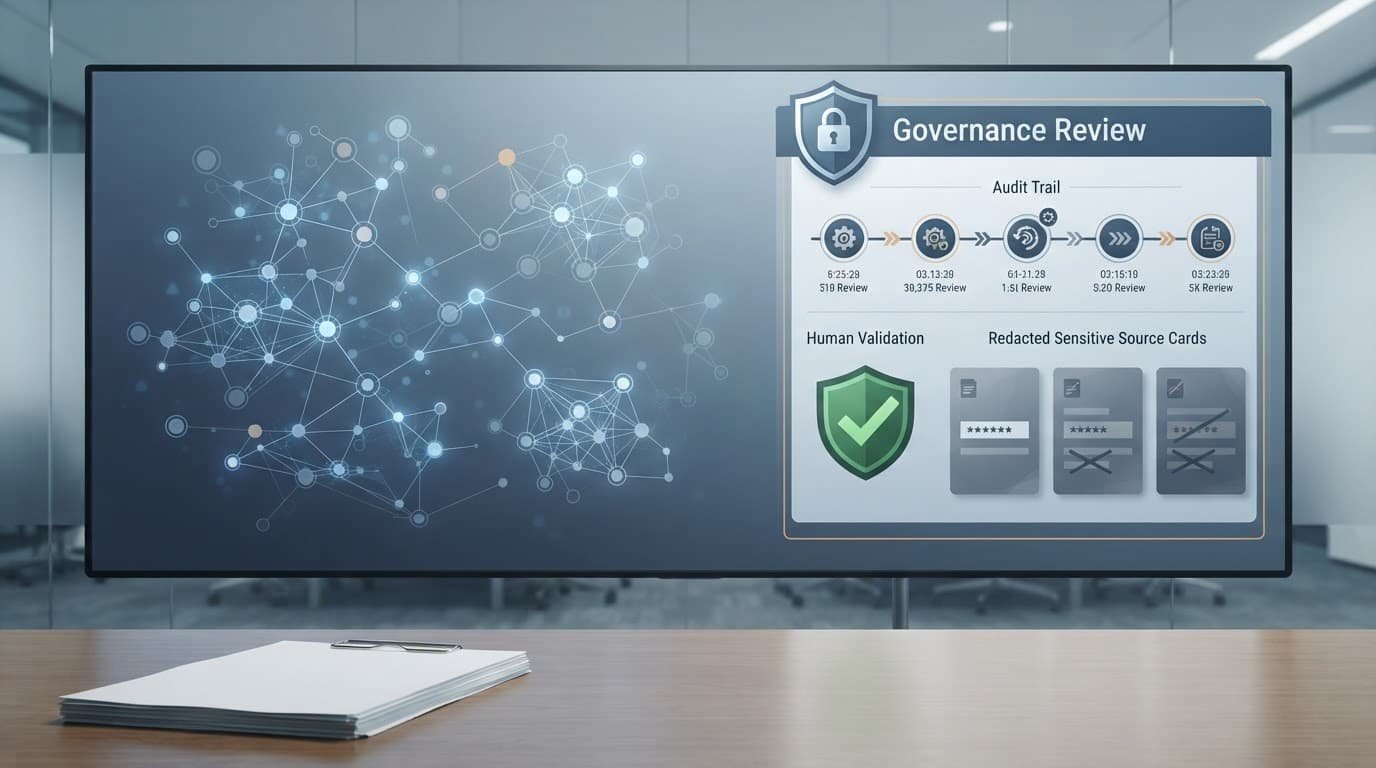
Maintain version history and audit trails after each cycle. Document what changed, who approved it, and which evidence caused the change. These records preserve organisational memory across review cycles.
Use prompts that require evidence
Prompts should limit the model’s freedom to invent. Tell it where the evidence begins and ends, and require it to mark uncertainty.
“Use only the supplied material. Extract stakeholders, stated concerns, named relationships, and dates. Cite the source identifier and quote for every field. Mark unknown when evidence is absent.”
“Challenge this stakeholder map. Flag weak claims, duplicate names, unsupported relationship links, and missing groups. Separate direct statements from inferences. Do not assign power or intent without evidence.”
These instructions reduce hallucinations, but they don’t remove them. A consultant still needs to read the underlying material and test findings in conversations.
Choose tools based on risk, scale, and control
Personal AI assistants and institutional AI systems solve different problems. The right choice depends on data sensitivity, project duration, number of stakeholders, and the client’s governance requirements.
Personal assistants suit bounded synthesis work
ChatGPT and Claude can help a consulting team summarize approved notes, build draft issue clusters, challenge an early matrix, or rewrite engagement messages. They work best when the source set is limited and a reviewer checks every output.
Use an approved enterprise environment if confidential material is involved. Retention settings, training controls, integrations, model behavior, and security terms vary by plan and can change over time. Confirm current settings with the client rather than relying on old procurement notes.
Institutional platforms suit long-running programs
Stakeholder-management platforms can provide persistent records, structured profiles, engagement logs, permissions, reporting, and audit history. Products such as Simply Stakeholders and Tractivity may fit programs that need those controls, although available features and AI functions differ by package and change over time.
Institutional AI is most useful when it preserves organisational memory across a multi-year program and reduces knowledge loss. Even then, the consulting team should pilot it on a limited, low-risk workstream before committing the client to a broad rollout.
Protect confidentiality, consent, and the audit trail
Stakeholder analysis often touches political views, employee concerns, commercial relationships, and sensitive community issues. Those sensitivities make data privacy a governance concern before they become a technical one.
Protect data at the point of collection
Do not upload confidential client information into a consumer AI account unless the contract and approved environment permit it. Minimize personal data, redact unnecessary identifiers, and restrict access to people who need it for the agreed purpose.
Consent needs separate attention. Attendance at a meeting doesn’t automatically authorize transcript analysis or sentiment scoring. Client legal, privacy, HR, and records teams should review collection notices and engagement terms against applicable compliance requirements, especially when employees, community representatives, or regulated groups are involved.
Stakeholder management includes identifying and engaging affected groups. In AI-assisted work, it also requires clarity about how their information will be used.
Maintain a defensible review record
Maintain audit trails for each material AI-generated finding. Document relevant governance controls, including the source reference, extraction date, workflow or model used, reviewer, approval status, and final action. When institutional AI is used, record its environment and access settings. Also record whether each finding is direct evidence or an inference. On projects headed toward acquisition or audit, that same discipline supports an evidence-ready diligence trail, and dedicated due diligence prompts can help you structure it.
Bias reviews also belong in that record. Models can overweight people who write more, appear frequently in documents, or hold public-facing roles. They may underrepresent workers, community members, or operational staff who have less written visibility but substantial project knowledge.
Client review should test the proposed engagement strategies for fairness and completeness. Reviewers should check for missing stakeholders, unsupported claims, and underrepresented operational or community voices. This protects the people in the map and improves the advice that follows.
Frequently Asked Questions
What is AI stakeholder mapping?
AI stakeholder mapping uses artificial intelligence to identify and organize stakeholders, concerns, relationships, and influence signals from approved project evidence. It supports stakeholder analysis, but human judgment and client validation are still required to interpret context and confirm findings.
How does AI improve stakeholder analysis?
AI can process large volumes of interview notes, workshop transcripts, surveys, communications, and project documents more quickly than a manual review. It can surface recurring themes, possible relationships, and changes in sentiment, while consultants determine whether those signals are meaningful and supported by evidence.
What should a stakeholder map include?
A useful map should include each stakeholder’s role, influence, interest, current stance, key concerns, relationship links, confidence level, source references, and next engagement action. It should also distinguish known evidence, inferences, and unknown information.
Can AI determine who has the most influence?
AI can identify observable signals such as formal authority, funding control, repeated mentions, decision dependencies, and the ability to mobilize others. It cannot reliably determine informal power or intent without interviews, contextual knowledge, and review by the consulting team and client.
How can teams protect confidentiality when using AI for stakeholder mapping?
Teams should use only approved data in an authorized environment, minimize personal information, redact unnecessary identifiers, and define retention and access controls. They should also document consent, source references, model or workflow details, reviewers, approvals, and whether each finding is direct evidence or an inference.
Final Thoughts
A stakeholder map becomes valuable when it turns scattered evidence into better conversations and timely decisions. AI can accelerate that work, but human judgment determines whether the map reflects the client’s real relationships.
Use AI to extract, compare, flag, and organize. Consultants and client stakeholders should validate what matters, decide how to engage, and preserve a defensible record that supports organisational memory beyond the project.