Hypothesis Tree Prompts for Consulting Teams

When a client says profit has stalled, every plausible cause can feel urgent. A solid hypothesis tree turns that noise into claims you can test, support, or discard.
Well-written hypothesis tree prompts give AI enough context to suggest a disciplined first pass. Yet the output cannot know the client’s politics, operating limits, or hidden data definitions.
Use AI to reduce blank-page time, then apply consultant judgment to choose the questions and evidence that matter.
Start with a testable decision question
Begin with a decision a client could act on, such as, “How can the consumer division improve operating profit in the next 12 months?” The metric, time frame, business boundary, and decision owner give the tree its shape.
Without those limits, a tree becomes a catalog of business ideas. A useful root question tells the team what to analyze and what to leave out.
Separate issues from hypotheses
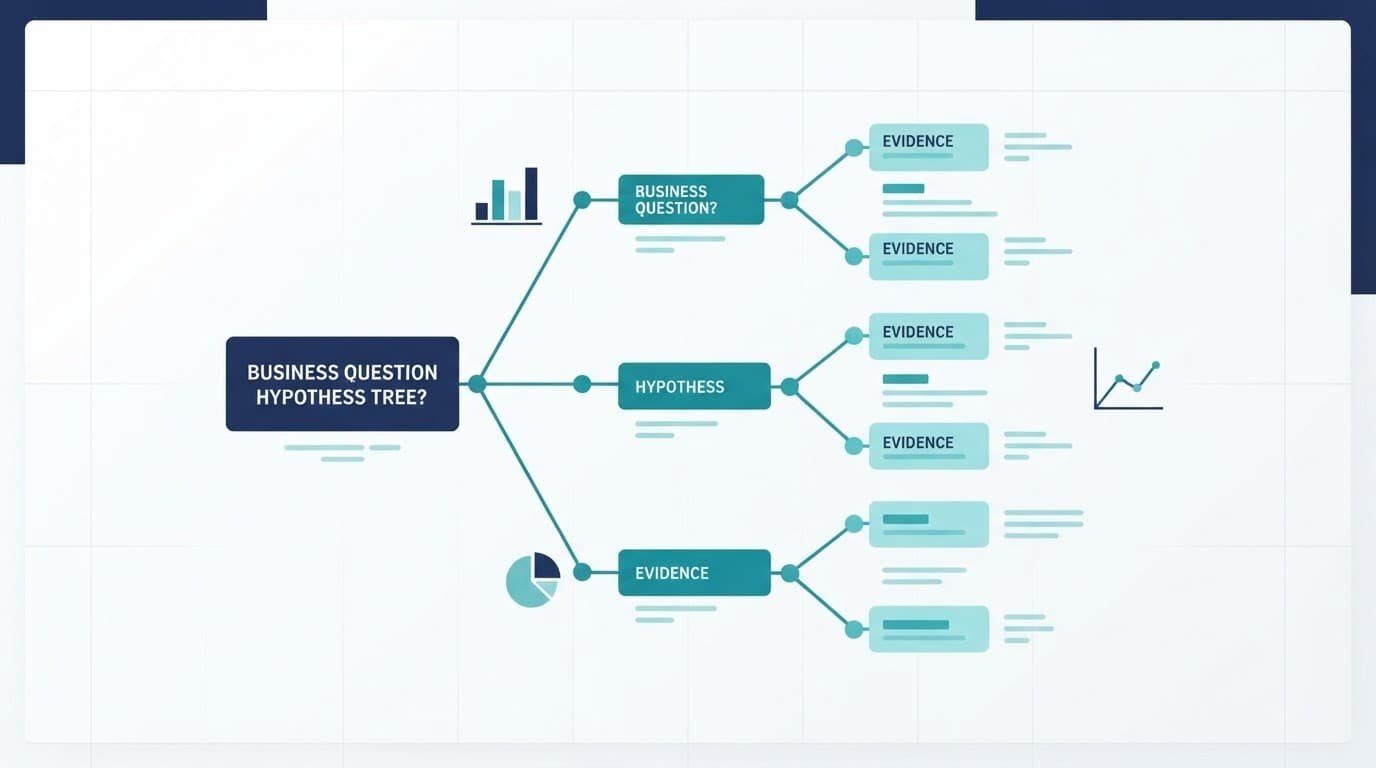
An issue tree asks what drives an outcome. A hypothesis tree goes further by stating a provisional explanation for each branch.
For example, “Operating profit is below plan” is an issue. “Labor hours per transaction rose in high-volume stores” is a testable hypothesis. The second statement tells an analyst what data could confirm or reject it.
Issue tree guidance from StrategyU describes the same core discipline: break a broad problem into component parts that a team can act on. At the first level, keep a single logic type. Use profit drivers, customer journey stages, or market segments, but don’t mix them.
Use MECE as a quality test
MECE means mutually exclusive and collectively exhaustive. In plain terms, branches should not double-count the same driver, and together they should cover the meaningful routes to the outcome.
A MECE framework overview can help when a tree feels disorganized. Still, MECE is a test, not a reason to force artificial symmetry. A two-branch tree may be stronger than five shallow branches.
If a branch cannot change a client decision when tested, it belongs in background context rather than the core tree.
Why hypothesis tree prompts need a strong brief
AI needs a case brief, not an open invitation to brainstorm. When the input lacks boundaries, it may fill the gaps with familiar business drivers that don’t fit the engagement.
Before using hypothesis tree prompts, assemble a short fact pack. Mark uncertain facts as unknown. That prevents assumptions from quietly becoming part of the problem definition.
Build an input pack before prompting
Give the model enough project context to structure the case without asking it to invent details.
| Include | Example | Why it changes the tree |
|---|---|---|
| Decision question | Improve store operating profit | Sets the root and value metric |
| Scope | Company-operated US stores only | Excludes irrelevant units |
| Known facts | Traffic fell in urban locations | Anchors initial branches |
| Definitions | Profit excludes corporate overhead | Prevents metric confusion |
| Constraints | No price increase before Q4 | Rules out unusable ideas |
| Decision owner | COO approves the plan | Keeps output decision-focused |
Short, disciplined inputs produce a more useful draft than a long narrative. Add source notes beside important facts so the team can trace what is verified.
The terms vary across firms. Issue trees, logic trees, and hypothesis trees often describe closely related ways to structure a problem. What matters is whether each branch leads to a testable claim.
Draft and red-team the first version
The first draft should create a shared starting point, not a finished answer. Ask AI to show its assumptions and expose weak branches early.
Prompt 1: Generate the first tree
Use this prompt when the team has a clear question but no agreed structure. Its purpose is to create candidate branches and evidence needs. Provide the root question, boundaries, known facts, and constraints. Expect a compact hierarchy with assumptions called out. Review each branch against the engagement scope and replace generic labels with the client’s actual measures.
You are supporting a strategy consulting workstream. Build a hypothesis tree for [decision question]. Context: [industry, geography, customer groups, period]. Known facts: [facts and source notes]. Constraints: [constraints]. Propose 3 to 5 distinct first-level hypotheses. For each, give causal logic, 2 to 4 sub-hypotheses, evidence required, and decision relevance. Flag overlaps, gaps, and assumptions. Do not add facts.
Prompt 2: Red-team the structure
Run this prompt after the project lead has edited the first draft. Its purpose is to identify logic flaws before analysts build workplans around them. Paste the tree and restate the root question. Expect a short change log and revised branches only where needed. Review the recommendations with a colleague who knows the client, because a structurally neat tree can still miss a political or operational constraint.
Act as an engagement manager reviewing this hypothesis tree: [paste tree]. Root question: [question]. Identify double-counting, mixed levels of logic, untestable claims, missing drivers, and branches outside scope. Rewrite only branches that fail these tests. For every change, explain the reason and add a question the consultant should verify with the client or data owner.
Prioritize tests before fieldwork begins
A tree can hold more hypotheses than a project can test. The next job is deciding where to spend scarce analysis time, interview slots, and data requests.
Prompt 3: Rank branches by learning value
Use this prompt once the tree has passed a logic review. Its purpose is to create an initial research sequence. Supply the branches, available data, time limit, and decision deadline. Expect a ranked queue with rationale, dependencies, and fast tests. Review the ranking against likely value at stake, then change it if the client has already committed to a decision path.
Prioritize these hypotheses for testing: [paste tree]. Available data and access: [data, interview access, systems]. Project time limit: [period]. Rank each branch by likely decision impact, uncertainty, feasibility, time to evidence, and dependency on another test. Return a ranked research queue, a reason for each ranking, and the fastest credible test for the top branches. Do not assign numerical scores without evidence.
Prompt 4: Turn one branch into an evidence plan
Use this when a workstream needs a concrete analysis plan. Its purpose is to convert a broad claim into evidence that could change the recommendation. Provide one hypothesis, known data sources, access limits, and the decision it informs. Expect a research plan with a decision rule and possible confounders. Review whether the proposed test measures cause rather than correlation, and confirm that the data owner can provide the required fields.
Turn this hypothesis into an evidence plan: [hypothesis]. Project context: [context]. Available sources: [sources]. Access limits: [limits]. State the evidence that would support or weaken the hypothesis, the data fields needed, analyses to run, interview roles to include, likely confounders, and a minimum decision rule. Separate facts to collect from assumptions to test.
Worked example: improving Starbucks store profit
A public-company practice case makes the method easier to see. Assume the root question is: “How could Starbucks improve company-operated North American store-level operating profit over the next 12 months?”
Refine the initial tree with AI
A rough first tree might include transactions, average ticket, product cost, labor cost, and occupancy costs. It is workable, but it doesn’t show where branches overlap or how a team would test them.
After applying the red-team prompt, the revised tree could read:
- Completed transactions: traffic, conversion, throughput, and product availability.
- Contribution per transaction: realized price, product mix, and promotional discounts.
- Product cost: ingredient cost, portion control, and waste.
- Store labor: scheduled hours per transaction, wage mix, and overtime.
- Occupancy and other fixed costs: leases, utilities, repairs, and maintenance.
The consultant should still challenge the structure. Product mix may affect both transaction contribution and product cost, so the workplan needs a rule for where that analysis sits.
Ask validation questions before accepting the tree
The next step is not more prompting. It is targeted fact gathering with finance, operations, and commercial leaders.
- Does the case cover company-operated stores, licensed stores, or both?
- Which margin line matters to the decision maker, store contribution or segment operating margin?
- Are transaction declines caused by lower demand, limited capacity, stockouts, or shorter trading hours?
- Can the team compare stores by format, region, maturity, and labor model?
- Which actions fit brand standards, lease timing, and labor agreements?
Review AI output like an engagement manager
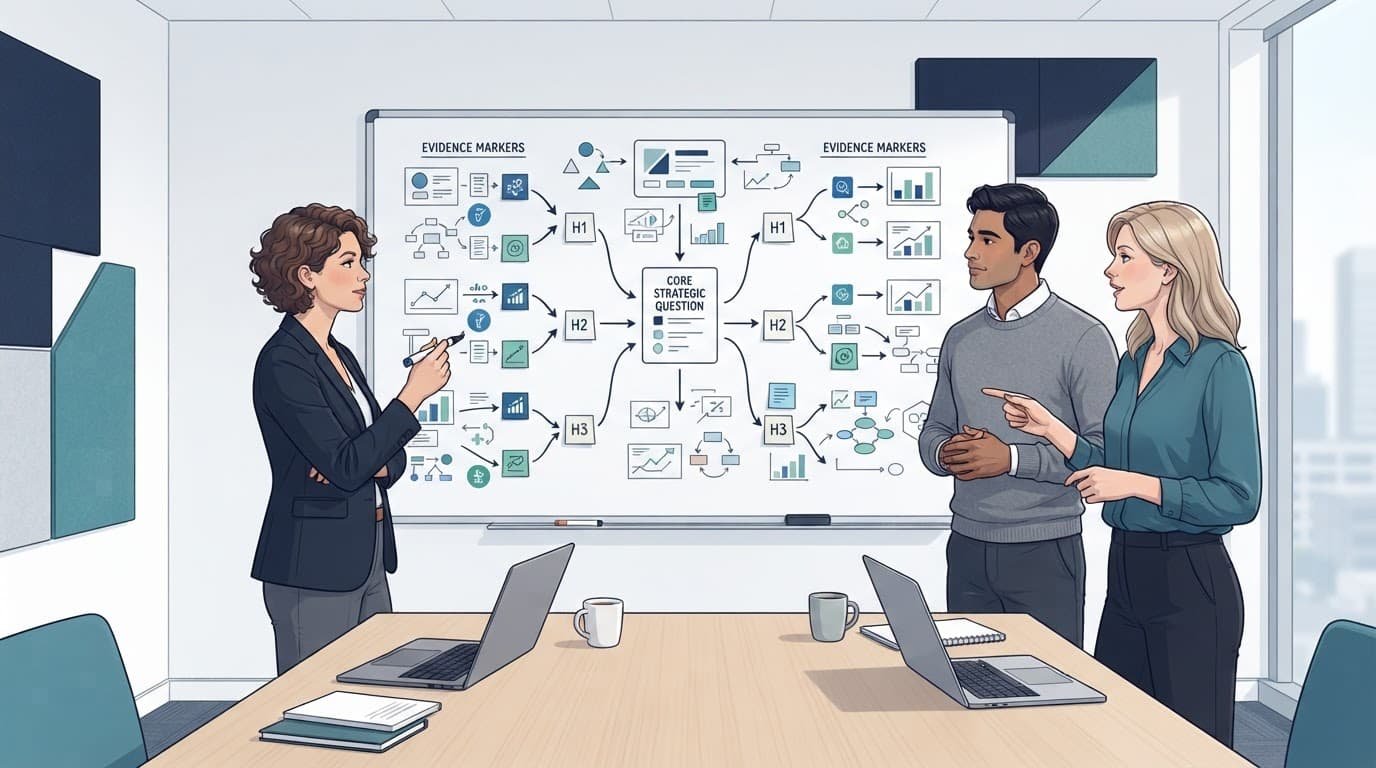
A polished tree can still hide unsupported claims. Review the logic before assigning analysis, and keep a clear separation between known facts, working assumptions, and findings.
Check branch quality before analysis
Each branch should be at the same level of logic as its peers. It also needs an observable indicator, a plausible causal link, and a path to evidence.
Compare the output against MECE checks for issue trees when branches feel repetitive. Then ask whether any external factor, such as regulation, competitor action, or capacity limits, belongs in scope.
Keep client context and evidence in human hands
Consultant judgment remains accountable for the problem definition, evidence standard, and recommendation. AI can suggest questions, but it cannot verify internal numbers, interpret a tense stakeholder interview, or decide whether a recommendation fits the client’s risk tolerance.
Use approved systems for client material. Remove identifiable data where required, and don’t paste sensitive records into an unapproved environment. Keep a source log for every factual input that survives into the final deck.

Final thoughts
Good consulting trees make the path from question to evidence visible. AI can speed up the first draft, stress-test the logic, and turn priority branches into research plans.
The strongest hypothesis tree prompts remain grounded in a clear decision, tight scope, and verified facts. The consultant owns the judgment that turns a well-structured tree into advice a client can trust.