How to Spot a Prompt Tested on Real Models

A prompt can sound smart and still be unproven. The easiest mistake in prompt testing is to judge the wording, not the results.
If you buy, share, or save prompts for real work, you need stronger evidence than a clean template. Real testing leaves fingerprints in the prompt itself, and once you know what to look for, those fingerprints stand out fast. To run your own tests with a repeatable process, follow our step-by-step guide to testing ChatGPT prompts.
Real testing leaves visible fingerprints
A tested prompt usually looks a little less elegant than a theory-first prompt. That’s because it carries the history of past failures.
You see that history in oddly specific rules. A line like “If the source text does not name a metric, do not infer one” didn’t appear for style. Someone watched the model invent a number, then added the guardrail. The same goes for lines such as “ask up to 3 clarifying questions only if core inputs are missing” or “return ‘insufficient information’ instead of guessing.”
That is why iteration history matters. A prompt that has survived real runs often contains instructions that feel defensive, narrow, or repetitive. Those aren’t flaws. They’re repair marks.
OpenAI makes the same point in its prompt engineering guide, which favors clear instructions, examples, and explicit output formats. A broader overview from Patronus on AI test prompts also treats testing as an evaluation problem, not a writing exercise.
Iteration history is part of the evidence
When someone says a prompt was tested, the best proof is not the claim. It’s the trail.
Strong evidence includes model names, output samples, dates, version notes, and short comments about what changed. If a prompt author can say, “This worked in ChatGPT, but Claude needed a softer instruction around tone,” that usually comes from actual runs. If they can say, “We re-checked it after a model update,” even better.
By contrast, untested prompts often read like first drafts. They describe an ideal result, but they don’t show what happened when the model missed.
If a prompt tells the model what to do when information is missing, someone probably watched it fail without that rule.
That single detail, fallback behavior, is one of the clearest signs that prompt testing happened on real models instead of on paper.
What tested prompts look like on the page
You can often spot a tested prompt before you run it. The structure gives it away.
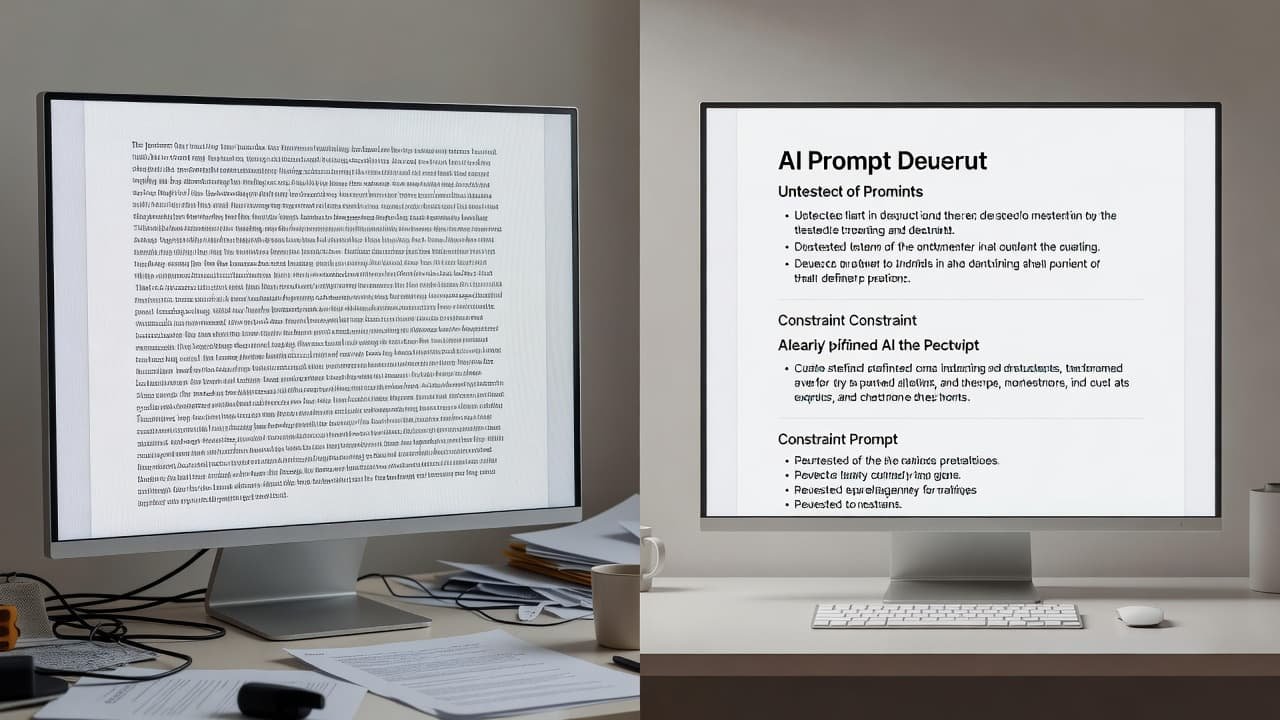
A tested prompt usually shows more structure because someone has already tightened loose parts.
Tested prompts tend to separate context, task, constraints, output format, and review steps. Sometimes that appears as simple Markdown sections. Sometimes it shows up as XML-style tags or labeled blocks. Either way, the point is the same. The writer is reducing ambiguity because they already know where the model drifts.
A second sign is built-in verification. For ChatGPT, that might look like “draft the answer, then check it against the brief, then revise.” For Claude, it may look more like a self-audit: identify weak assumptions, missing evidence, and open questions before finalizing. Recent write-ups on LLM evaluation metrics treat that review loop as part of quality control, not an optional extra.
Constraints, fallbacks, and edge cases
Three features show up again and again in tested prompts.
First, constraints are concrete. They name a word range, reading level, format, banned claims, or source boundary. Vague instructions like “make it compelling” or “sound professional” are common in untested prompts because nobody has yet pinned down what “good” means.
Second, fallback handling is explicit. If data is missing, the model gets a rule. If the user input is contradictory, the prompt defines a response. If the request crosses a boundary, such as legal or medical advice, the prompt tells the model how to step back.
Third, tested prompts cover awkward inputs. A good extraction prompt doesn’t only work on clean notes. It also handles broken formatting, missing names, duplicate bullets, and half-finished thoughts. Many teams keep 5 to 10 core cases plus edge cases for this reason, then rerun the same bank whenever they revise the prompt.
You also see examples more often in tested prompts, including bad examples. When a prompt says, “Do not write generic praise like ‘innovative company’ or ‘leading brand’,” it is closing a loophole that opened in earlier runs.
Different models expose weak prompts fast
A prompt that works once in one model is not strong proof. Model differences matter, and they show up in the wording.
ChatGPT usually responds well to direct instructions, strong formatting rules, and clear success criteria. Claude often benefits from richer context, continuity across turns, and a little more interpretive room. Portkey’s comparison of prompting ChatGPT and Claude points to those differences, and Anthropic’s post on effective context engineering explains why fuller context can change Claude’s behavior.
This matters because tested prompts often reveal which model shaped them. A ChatGPT-tested prompt may sound strict: exact sections, exact length, exact output order. A Claude-tested prompt may keep the same goal but phrase the review step more conversationally, with instructions to surface assumptions or uncertainty.
Model-specific wording is not a problem. Hidden model dependence is the problem.
If a seller or creator says a prompt is universal, check whether it contains language that only one model follows consistently. Also check whether they show outputs from more than one system, such as ChatGPT, Claude, Gemini, or Grok. When outputs vary, that is normal. What matters is whether the author noticed the variation and adjusted for it.
A well-tested prompt often handles this in one of two ways. It either names the target model and version, or it includes wording designed to survive across models. For example, it may ask for a confidence note, define a fallback for missing facts, and keep formatting simple enough that several models will obey it.
Untested and tested prompt examples
A quick comparison makes the pattern easier to spot.
| Signal | Untested prompt | Tested prompt | | | | | | Goal | “Write a cold email” | Names the audience, offer, and outcome | | Constraints | Few or none | Word count, tone, banned claims, format | | Missing data | Ignores it | Tells the model what to do if details are absent | | Review step | None | Self-check for accuracy, compliance, or style | | Edge cases | Assumes clean input | Covers weak inputs, contradictions, and blanks | | Model notes | None | Mentions where it was run or adjusted |
The takeaway is simple. Tested prompts are narrower because they were forced to become narrower.
Here is a realistic example for a marketer.
Untested version
Write a cold email for my SEO agency.
That prompt might work. It might also produce fluff, fake personalization, spammy claims, or a 250-word wall of text.
Tested version
You are writing a first-touch cold email for a local SEO agency.
Goal: book a 15-minute intro call with US law firms that have 2 to 10 locations.
Use 90 to 120 words. Keep the tone plain and respectful. Do not claim results, invent traffic numbers, or use hype.
Mention one likely issue these firms face with local search visibility, but only in general terms.
If company details are missing, write a reusable template and place personalization fields in [BRACKETS].
Output 3 subject lines, then the email. After drafting, remove spam-trigger phrases and any sentence that sounds generic.
This version looks tested because every line solves a known failure. The audience is defined. The outcome is defined. The word limit exists because models ramble. The ban on invented numbers exists because models invent numbers. The bracket rule handles missing data. The final self-check addresses spammy language.
That is prompt testing in plain view.
A quick checklist before you trust any prompt
Use this short screen before you save a prompt or pay for one.
- Check whether the prompt defines the task, audience, and output format in concrete terms.
- Look for fallback behavior when information is missing, weak, or contradictory.
- See whether it includes a review step, such as verification, self-audit, or confidence notes.
- Notice whether it covers edge cases, not only clean inputs.
- Ask whether the wording feels model-aware, or whether it pretends all models behave the same.
- Give more weight to prompts that show sample outputs, model names, and a recent re-test date.
If you want to formalize that process, tools like Promptfoo, Helicone, and OpenAI Evals can help. Helicone’s overview of prompt evaluation frameworks is a useful place to compare approaches.
Final thoughts
A tested prompt rarely looks magical. It looks careful, a little strict, and slightly battle-worn.
That is the mark of real prompt testing. Good prompts carry proof of contact with actual models, because somebody ran them, watched them break, and fixed what broke.